 Oil Press Equipment and Oil Refining Machinery for Sale – Start Your Oil Press Business
SEARCH WHAT YOU WANT
Search allProductNews
SEARCH
Edible oil refining uses a combination of process vessels, separators or filters, heating and cooling equipment, vacuum systems, pumps, and controls. The exact configuration depends on your crude oil, processing capacity, and finished oil requirements. A suitable system may include degumming, neutralization, bleaching, deodorization, and dewaxing where needed.
At Fude Machinery, we recommend starting with your feed oil and production goals before choosing individual machines. This guide explains the main equipment groups, how they work together, and which supporting facilities you should consider when planning your project.
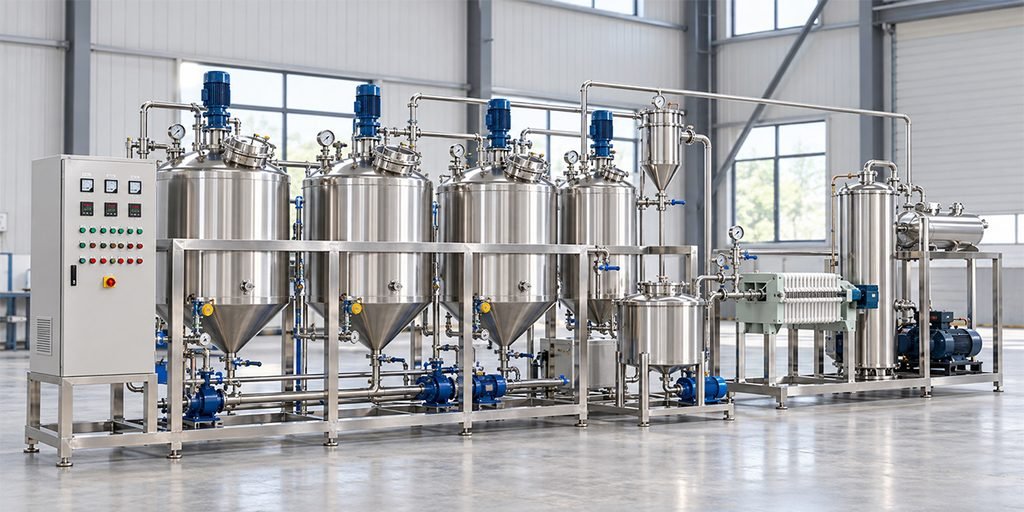
An edible oil refinery combines several treatment stages, each with a different purpose. The equipment should work as a coordinated system. Selecting separate machines without checking their capacity and operating requirements can create production bottlenecks.
| Process Stage | Main Purpose | Typical Equipment |
|---|---|---|
| Degumming | Reduce phospholipids, often called gums | Mixing or reaction vessels, dosing equipment, and separation equipment |
| Alkali neutralization, when selected | Reduce free fatty acids through a chemical refining route | Neutralization vessels, dosing systems, and soapstock separation equipment |
| Bleaching | Reduce pigments and certain unwanted components through adsorption | Bleaching vessels, adsorbent dosing equipment, and filters |
| Deodorization and physical deacidification, where applicable | Remove odor compounds and, in suitable physical refining systems, free fatty acids | Deodorization equipment with heating, stripping steam, and vacuum systems |
| Dewaxing or winterization, when required | Reduce waxes or other components that can cause cloudiness at lower temperatures | Controlled cooling or crystallization equipment and filters |
| Finishing and storage | Prepare treated oil for transfer to the next operation | Cooling equipment, final filtration where specified, pumps, and storage tanks |
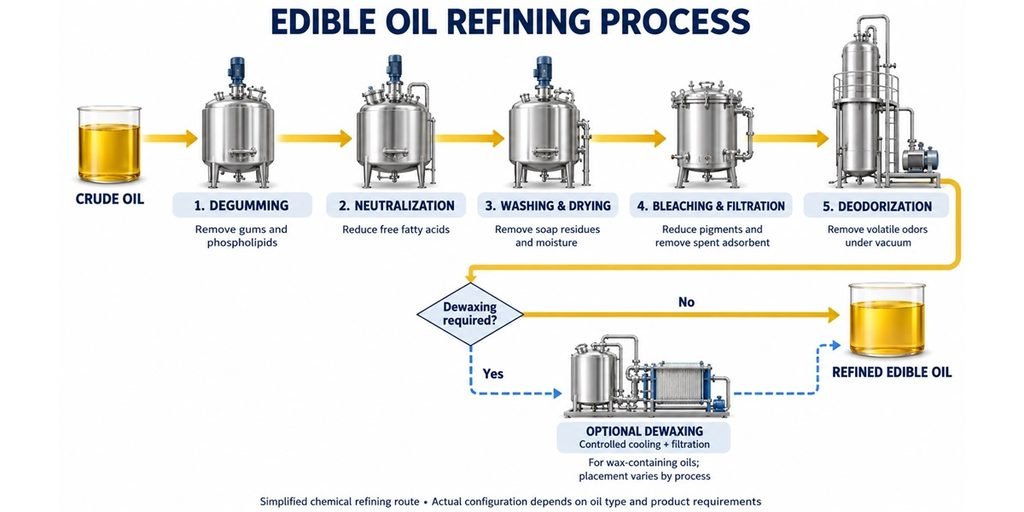
Degumming reduces phospholipids in crude oil. Depending on the selected process, the system may use mixing vessels, dosing equipment, controlled heating, and separation equipment.
We recommend checking the incoming oil analysis before selecting this stage. Different crude oils can require different treatment conditions. The amount and form of the phospholipids also affect the process choice.
Deacidification reduces free fatty acids. In a chemical refining route, alkali neutralization forms soapstock that must be separated from the oil. Washing and drying equipment may also be required, depending on the design.
In a suitable physical refining route, free fatty acids are removed by distillation under vacuum, often in connection with deodorization. This route requires appropriate pretreatment and feed oil quality.
We recommend asking the supplier to explain why the proposed route fits your crude oil. A neutralization vessel is not automatically required in every refinery. Physical refining should also be assessed against the feedstock and product requirements, rather than selected simply because it appears to use fewer stages.
Bleaching uses an adsorbent, such as bleaching earth, to reduce pigments and certain unwanted components. The process requires controlled contact between the oil and adsorbent, followed by separation.
A bleaching section may include a treatment vessel, dosing equipment, a vacuum connection, and suitable filters. The filters remove the spent adsorbent after treatment.
Deodorization uses stripping steam under vacuum to remove volatile compounds associated with unwanted odors and flavors. The system requires suitable heating, vacuum generation, vapor handling, and cooling arrangements.
A heated tank alone should not be treated as a complete deodorization system. We recommend confirming the supporting equipment, utility requirements, and operating conditions in the proposal.
The selected conditions should suit the oil and the required finished product. A single temperature or treatment time should not be presented as suitable for every oil. Ask how the proposed system will be operated and how its performance will be checked.
Some oils need additional treatment to meet clarity requirements at lower temperatures. When this treatment is necessary, the system may include controlled cooling, crystallization, and filtration.
The need for this equipment depends on the oil composition and the intended product specification. We recommend discussing expected storage conditions and any required clarity test before adding or excluding this stage.
If low-temperature clarity is important to your buyer, include that requirement in the initial inquiry. This allows it to be considered during process selection rather than added after the main equipment has been chosen.
An oil press extracts oil from prepared oilseeds. A refinery treats crude oil after extraction. These operations can be connected in a complete production line, but they perform different jobs.
If you buy crude oil from another producer, your refinery project may not need an oil press. If you plan to process seeds and sell refined oil, the project must include compatible extraction and refining sections.
For a pressing project, you can review our screw oil press equipment separately. Its capacity should be stated as oilseed input, while refinery capacity should clearly identify the crude oil feed basis.
Do not assume that a press handling one ton of seeds supplies one ton of crude oil to the refinery. The actual oil supply depends on the raw material and extraction conditions.
We recommend sharing both the planned seed-processing volume and the expected crude oil supply when discussing a complete line. This helps identify whether intermediate storage or a different operating schedule is needed between pressing and refining.
Ordinary mechanical filtration removes suspended solids, but it does not replace all refining stages. Oil that looks clear may still have properties that need further treatment to meet the intended product specification.
We recommend separating visible sediment problems from requirements such as acidity, odor, and low-temperature clarity. These issues may require different treatment stages.
For example, a filter can remove suspended particles within its operating capability. It should not be assumed to provide the same treatment as neutralization or deodorization.
If you already have an oil filter, share its type, capacity, and current purpose. Its specifications can then be reviewed against the proposed configuration. The presence of a filter alone does not establish that other refining equipment can be omitted.
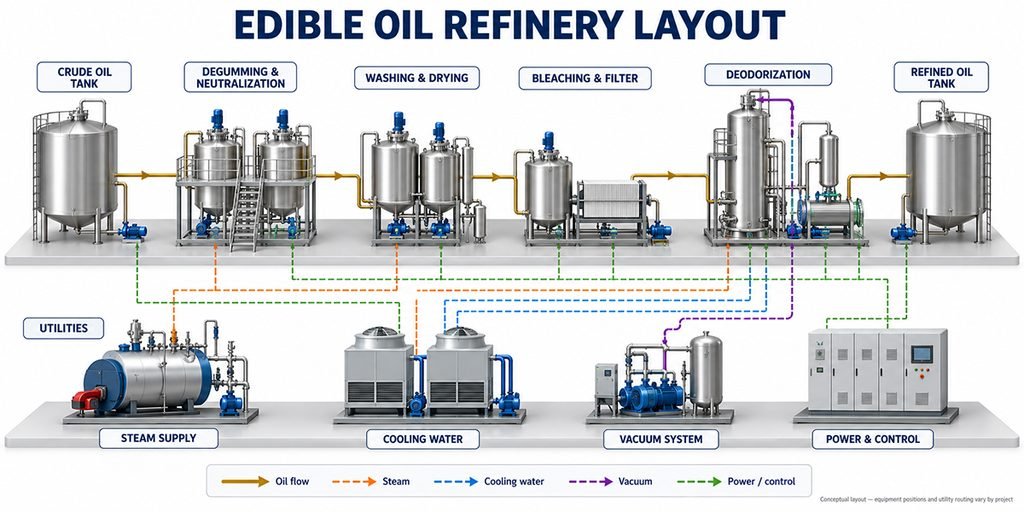
The main process vessels are only part of an edible oil refining system. Reliable operation also depends on compatible utilities, transfer equipment, controls, and storage.
The supporting equipment should be sized for the proposed process. We recommend identifying what the supplier will provide and what your factory must arrange before comparing quotations.
| Supporting Item | What to Confirm |
|---|---|
| Heating system | Required heat source, available supply, and equipment included |
| Vacuum system | Process requirements, system scope, and supporting utilities |
| Cooling system | Cooling duty, water availability, and proposed circulation arrangement |
| Pumps and piping | Compatibility with the oil, operating conditions, and transfer requirements |
| Storage tanks | Feed and finished oil storage needs, capacity, and transfer connections |
| Electrical controls | Power supply, monitoring, alarms, and proposed automation level |
| Residue handling | Arrangements for soapstock, spent adsorbent, and other process residues |
| Installation materials | Responsibility for valves, cables, insulation, platforms, and site connections |
Not every item will have the same design in every project. An existing factory may already have suitable heating or cooling facilities. Their specifications must still be checked against the new equipment requirements.
Tell the supplier what is available at your site, including electrical supply, heating facilities, water, and cooling arrangements. Mark unknown information clearly so it can be resolved during project planning.
We start with four questions: what oil you will process, what condition it arrives in, how much you need to process, and what finished product you must produce.
These answers help define the process scope before individual equipment is selected.
Provide the exact oil type, its source, and any treatment it has already received. If an analysis report is available, include the original results, units, and sampling information.
If you plan to process several oils, list all of them. A configuration proposed for one feedstock should not automatically be assumed suitable for another.
We also recommend explaining known variations between suppliers or batches. A single test result may not represent the full range of incoming oil your plant will receive.
If you do not have an analysis report, provide the information you know. The technical discussion can then identify which additional tests or details are needed before the configuration is finalized.
State your required crude oil input in kilograms per hour, metric tons per day, or kilograms per batch. Include the planned operating schedule.
For batch systems, the full cycle matters. Filling, treatment, transfer, heating, cooling, and cleaning can all affect the usable production schedule. The volume of one vessel does not establish the daily capacity of the entire system.
We recommend keeping startup requirements separate from future expansion plans. This allows the proposal to explain what can be added later and what would require replacement or redesign.
Tell us how the oil will be used and where it will be sold. Attach your buyer’s specification or applicable product requirements when available.
Avoid relying only on descriptions such as “high quality” or “clear oil.” The proposed process should be assessed against defined requirements and agreed feed conditions.
Requirements may concern acidity, moisture, color, odor, or other characteristics relevant to the oil and its intended use. The appropriate targets and test methods should be identified during the technical discussion.
Share available floor space, clear height, access openings, and utility information. For an existing plant, include a layout and details of equipment you want to retain.
We recommend considering maintenance access and operator movement as part of the layout. Equipment that fits inside a building may still need additional space for operation and servicing.
Explain any restrictions affecting delivery and installation. Narrow doors, limited lifting access, or existing equipment can influence how the project is arranged.
A useful proposal should explain the process, list the equipment, and define the limits of supply. It should also identify the information or assumptions that still need confirmation.
Before accepting a configuration, check that the proposal addresses:
You can compare the proposal with our edible oil refining equipment overview. The final equipment list should be confirmed for your project rather than copied from a general product description.
No. The process depends on the incoming oil and the required finished product. Some projects need stages that others do not. We recommend selecting the process from the feed analysis and product requirements rather than assuming one equipment list fits every oil.
Some batch designs use shared vessels for compatible operations. This can affect production scheduling, cleaning, and capacity. Ask the supplier to explain which operations share equipment and how the full system achieves the proposed throughput.
The choice depends on processing volume, operating hours, product changes, staffing, and investment requirements. We recommend comparing complete configurations for your project instead of choosing from the process name alone.
An expansion may be possible, but the process equipment and supporting utilities must be reviewed together. Additional capacity can require changes to heating, cooling, vacuum, storage, controls, or transfer systems. Share the existing equipment specifications before requesting an expansion proposal.
Bottling should be treated as a separate scope unless the proposal explicitly includes it. If you need filling, capping, labeling, or packaging equipment, describe those requirements when discussing the project. Finished oil storage and transfer connections should also be confirmed.
The right refining configuration matches your crude oil, production schedule, finished product requirements, and available utilities. Start by defining these conditions, then compare equipment proposals with a clear scope of supply.
At Fude Machinery, we focus on discussing the equipment your project requires. You can learn more about our company and submit your project information through the contact options on our website.
Send us your oil type, planned crude oil processing capacity, destination country, and available test report. If some details are not yet confirmed, identify them in your inquiry so we can clarify the information needed for the equipment discussion.