 Oil Press Equipment and Oil Refining Machinery for Sale – Start Your Oil Press Business
SEARCH WHAT YOU WANT
Search allProductNews
SEARCH
Are you planning to invest in an edible oil refinery plant? Is your target capacity 10 tons per day? Do you want to know how to achieve a low-cost factory setup while ensuring oil quality? I am Fude Machinery. I have been deeply involved in the oil pressing machinery industry for many years. I understand your needs. I want to provide you with a practical 10 ton/day edible oil refinery configuration guide. This will help you start your refining business in the most economical and efficient way.
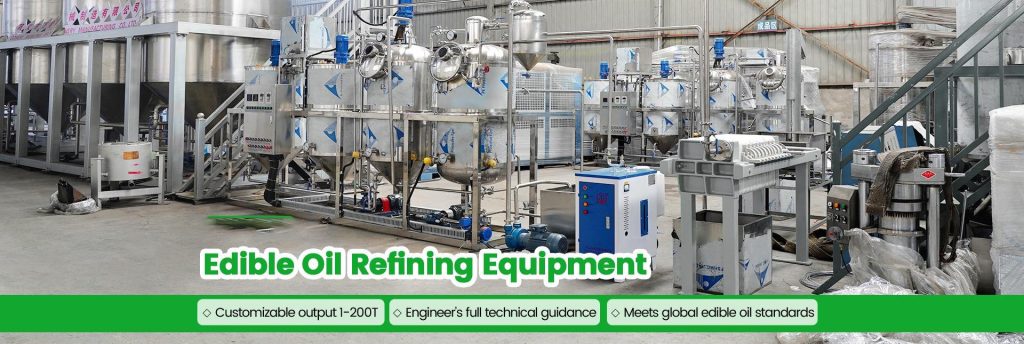
A 10 ton/day edible oil refinery is ideal for SMEs and first-time investors—it avoids small workshop limitations and large factory high costs, serving as a perfect entry point.
This capacity meets medium market demand, balances output and initial investment risk. Its semi-automatic configuration ensures easy operation, fewer workers and lower labor costs; its moderate footprint fits existing factories, cutting construction expenses.
Partnering with Fude Machinery gets you cost-effective, full-cycle support (design to production) for faster ROI and lower risks. The 10 ton/day scale guarantees stable market supply, critical for building brand reputation and market share—you can supply high-quality oil to local restaurants, supermarkets and communities for quick customer recognition.
It also offers flexibility in raw material procurement and sales, reducing reliance on single suppliers or distributors to boost bargaining power and profit control. Most importantly, it allows easy future upgrades and expansion to continuous production lines as your business grows.
Low-cost edible oil refinery factory setup hinges on smart planning, not just cost-cutting—and Fude Machinery specializes in delivering such value-driven solutions for customers.
The core strategy is optimization and simplification:
Smart investment is key. Prioritize semi-automatic refinery machines: they balance moderate cost, easy operation and 10 ton/day capacity needs, while reducing reliance on skilled operators and labor costs. Choose energy-saving equipment like high-efficiency heat exchangers with waste heat recovery to slash electricity and steam consumption.
Partnering with a reliable supplier like Fude Machinery is crucial—we provide cost-effective equipment plus full technical support and installation guidance, ensuring smooth production startup, avoiding rework delays and controlling overall setup costs.
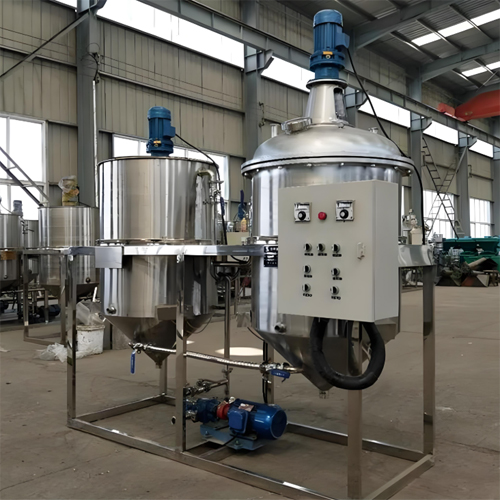
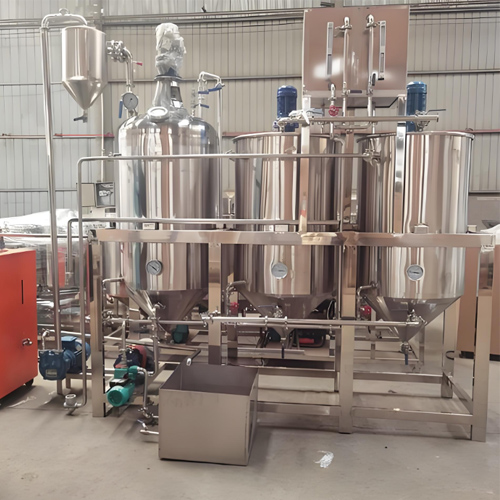
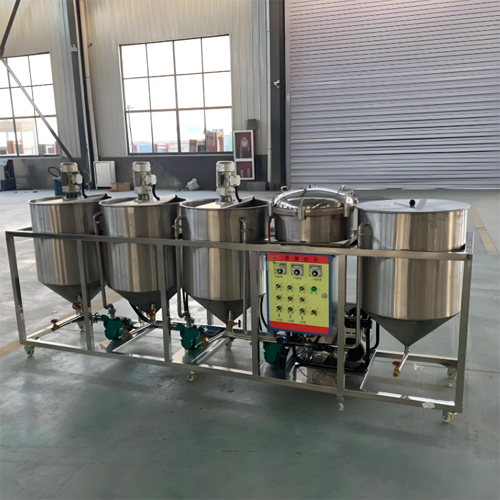
A 10 ton/day edible oil refinery machine is configured to complete four core refining steps: degumming, deacidification, decolorization and deodorization.
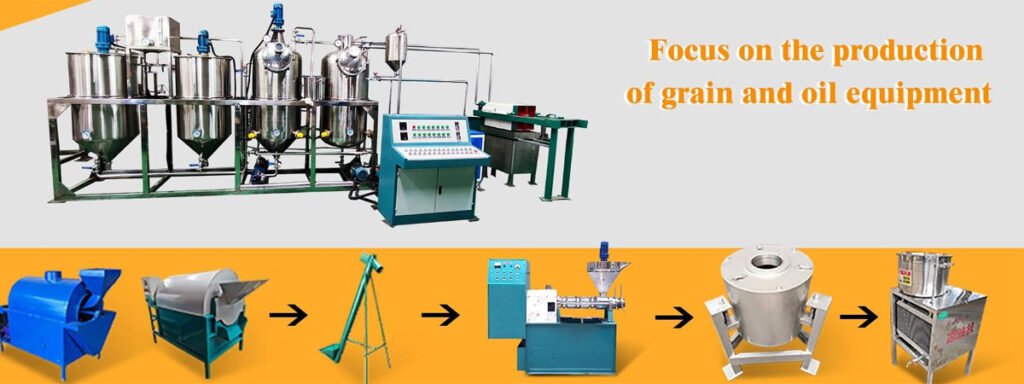
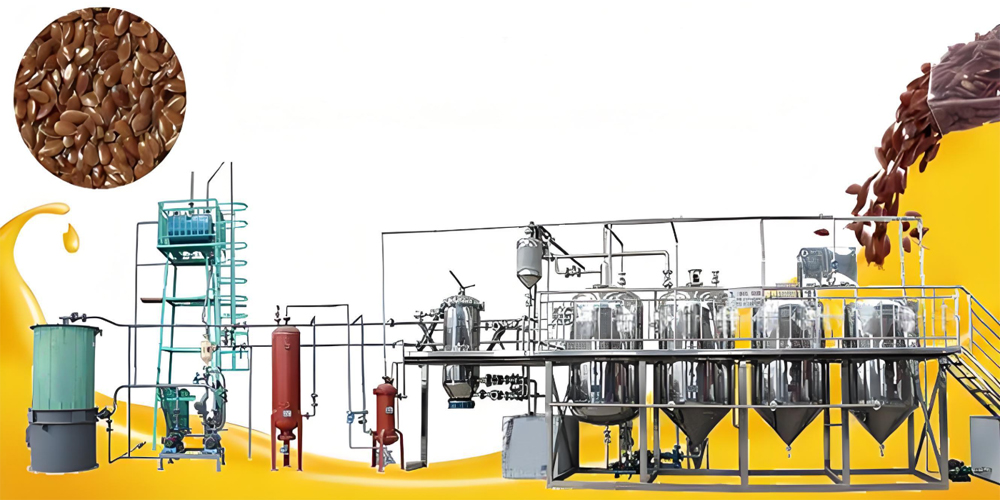
Its standard production line includes core equipment: crude oil tank, refining tanks, decolorization tank, deodorization tank, filtration equipment, vacuum system, thermal oil furnace/steam boiler, control cabinet and auxiliary devices. Each component serves a critical role: crude oil tank for storage; refining tanks for degumming and deacidification reactions; decolorization tank for pigment removal; deodorization tank for odor elimination under high-temperature vacuum; filtration equipment for removing impurities; vacuum system for providing negative pressure; thermal oil furnace/boiler for heat supply; control cabinet as the production line “brain” for centralized control.
Fude Machinery can optimize the configuration based on your specific needs and budget. Below is a list of basic configurations and their practical production significance:
| Equipment Name | Main Function | Practical Meaning for You |
|---|---|---|
| Crude Oil Tank | Stores unrefined crude oil | Ensures stable raw material supply, provides buffer for refining. |
| Refining Tank | Completes degumming and deacidification reactions | Removes impurities and free fatty acids from oil, improves oil purity. |
| Decolorization Tank | Removes pigments from oil | Gives oil a clearer, more market-friendly color. |
| Deodorization Tank | Removes odors from oil | Eliminates bad flavors from oil, ensures pure taste. |
| Filter Press | Filters solid particles from oil | Achieves clear and bright refined oil, enhances product appeal. |
| Vacuum System | Provides negative pressure for decolorization and deodorization | Guarantees refining effect, reduces oil oxidation risk. |
| Thermal Oil Furnace/Steam Boiler | Provides heat energy | Ensures temperature control during refining, improves efficiency. |
| Control Cabinet | Centrally controls all equipment | Simplifies operation, enhances automation and safety of the production line. |
Practical tips and advice for you
Actual case: I helped Mr. Zhang set up a 10 ton/day peanut oil refinery in Henan. He chose my recommended semi-automatic configuration. He also modified his existing factory building. He successfully kept his initial investment within his budget. Now, his refinery operates well. His products are very popular in the local market.
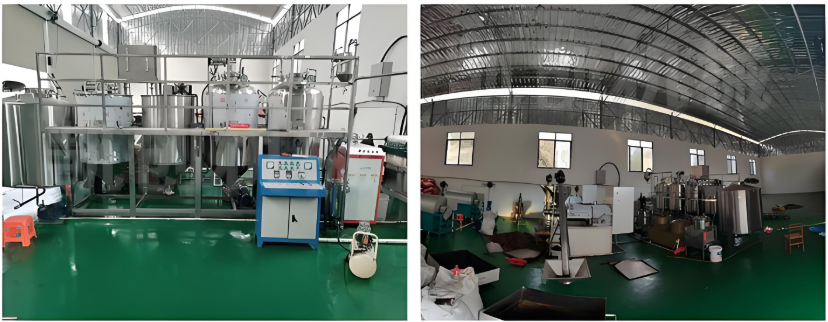
Optimizing the refining process is key to achieving a low-cost factory setup and boosting profits. A well-designed process can significantly reduce energy, material, and labor costs. It still ensures oil quality. I, Fude Machinery, have rich experience in this area.
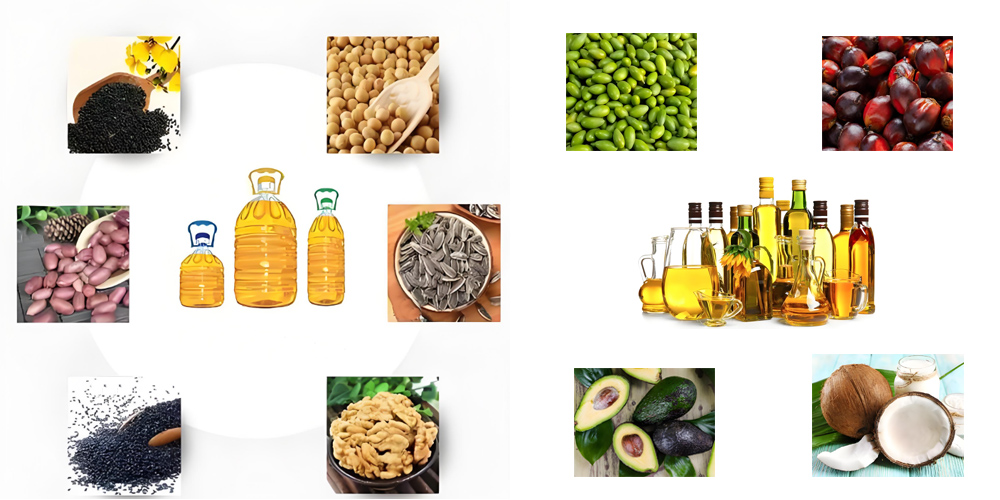
Optimizing the refining process starts with simplification. For a 10 ton/day capacity, I usually recommend a relatively simplified physical refining process. Or you can use a water washing and alkali refining combined process. Both methods effectively remove impurities from crude oil. Their costs are controllable.
For example, water degumming can replace phosphoric acid degumming. This reduces chemical use. For deacidification, you can consider physical deacidification. This uses high-temperature vacuum stripping to directly remove free fatty acids. It reduces alkali consumption and soapstock production.
Also, efficient filtration is a key part of cost reduction. Using advanced filtration equipment can effectively reduce the amount of decolorizing clay. It also reduces oil loss. Optimization at every step adds up to significant cost savings. I will also customize the most suitable process for you. This will be based on the type of oil you process. This ensures the best balance between efficiency and cost.
Process optimization is not just about equipment selection. It is also about process design and management.
10 ton/day edible oil refinery machine technology is always getting better. It meets new market demands for efficiency. It also meets new demands for environmental protection and cost-effectiveness. Knowing these latest trends will help you make smarter investment decisions.
Latest developments at a glance
Market insight: As consumers become more aware of food safety and health, demand for refined oil keeps growing. Especially in emerging markets and developing countries, local crude oil processing plants have a strong demand for small to medium-sized refining equipment. A 10 ton/day edible oil refinery machine is a cost-effective solution. Its market prospects are wide. Investment in this type of equipment is expected to keep increasing in the coming years.
Q1: How much capital is needed to build a 10 ton/day edible oil refinery plant?
The investment varies significantly based on automation level, equipment brand and factory conditions. Generally, with semi-automatic equipment and reasonable factory modifications, the total investment ranges from several hundred thousand to over one million RMB (covering equipment procurement, installation & commissioning, initial raw material reserves and partial operating costs). Clarify your needs and contact me for a detailed cost analysis to optimize investment planning.
Q2: Will building a low-cost plant affect oil quality?
No. Low-cost construction focuses on optimizing equipment configuration, simplifying processes and utilizing existing resources to cut unnecessary expenses, not sacrificing quality. For example, choosing cost-effective domestic equipment, using existing factories and adopting mature semi-automatic technology—with standard operations and proper refining processes, you can still produce high-quality edible oil meeting national standards. Fude Machinery provides professional guidance to ensure oil quality; this is our promise.
Q3: How many workers are needed to operate a 10 ton/day edible oil refinery machine?
The number depends on automation level: 2-3 workers can handle daily production and maintenance (feeding, process control, discharge, simple cleaning) for well-designed semi-automatic equipment; only 1-2 workers for monitoring fully automatic equipment. We will provide detailed staffing recommendations based on your final equipment selection to facilitate workforce planning.
Choosing the right 10 ton/day edible oil refinery machine and achieving a low-cost factory setup is key to your success in the edible oil industry. I, Fude Machinery, have provided you with detailed information. I explained the advantages of this capacity scale. I also gave you core strategies for a low-cost factory setup. I analyzed basic equipment configurations. I showed you methods to optimize the process flow.
I recommend the following: First, define your investment budget and market positioning. Second, prioritize modular, energy-efficient semi-automatic equipment. This will balance your initial investment with future operating costs. Finally, partner with a professional manufacturer like me, Fude Machinery. I will provide you with comprehensive support. This includes planning, design, equipment manufacturing, installation, debugging, and after-sales maintenance. This ensures your refinery operates efficiently and stably.
About Fude Machinery
I am Zhengzhou Fude Machinery. I am a professional oil pressing machinery research and production manufacturer. I focus on B2B business. I offer various Oil processing equipment products. These are mainly for food oil, refined oil, and oil machinery R&D applications. I have well-equipped facilities.
My product line is comprehensive. It includes single screw oil presses, hydraulic oil presses, roasting machines, vacuum oil filters, and complete oil mill production lines. I have exported my products to over 120 countries worldwide. I am committed to providing customers with cost-effective products and full-process services.
Are you ready to set up a low-cost factory and start your 10 ton/day edible oil refining business?
Contact Fude Machinery’s expert team today. Get a custom solution tailored for you. Let us work together to turn your business idea into reality!
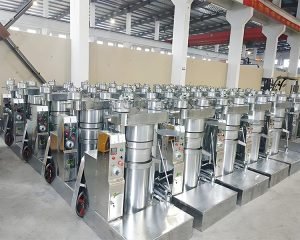
Hydraulic oil press, as a common oil pressing equipment, has a wide range of applications in the oil processing industry. The advantages and disadvantages are analyzed as follows: ,
View details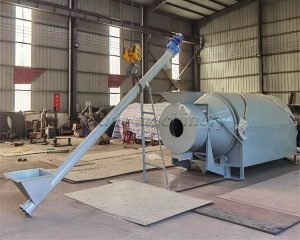
The application prospects of grain drum dryer are very broad
View details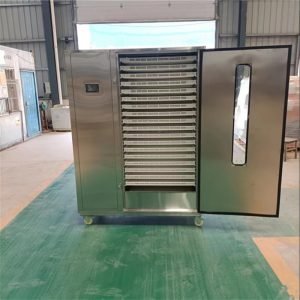
Box type dryer, also known as hot air circulation dryer or box type heat pump dryer, is a drying equipment widely used in multiple industries.
View details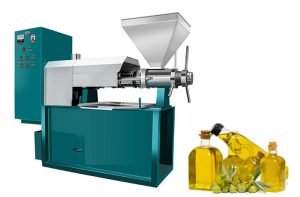
Spiral oil press is suitable for various types of oil, such as peanuts, soybean oil sunflower, olives, etc., and is divided into two types: cold press and hot press. Its working principle is to use a squeezing screw to rotate the oil, causing it ...
View detailsThis website uses cookies to improve your browsing experience. By continuing to use this site, you accept the use of our cookies. Data collected from this website is processed and stored in the United States.