 Oil Press Equipment and Oil Refining Machinery for Sale – Start Your Oil Press Business
SEARCH WHAT YOU WANT
Search allProductNews
SEARCH
To reduce oil loss during screw pressing, control the feed material, preparation, moisture, temperature, machine settings, and cake discharge. You also need to measure oil and cake using the same conditions. A higher oil content in the raw seed does not automatically mean that the press will produce the same oil output every time.
At Fude Machinery, we recommend checking the complete pressing process before changing the machine. Many oil loss problems begin before the seeds enter the press. Other problems come from worn parts, unstable feeding, poor filtration, or incomplete records.
This guide explains where oil loss can occur and what you can check before making equipment adjustments.
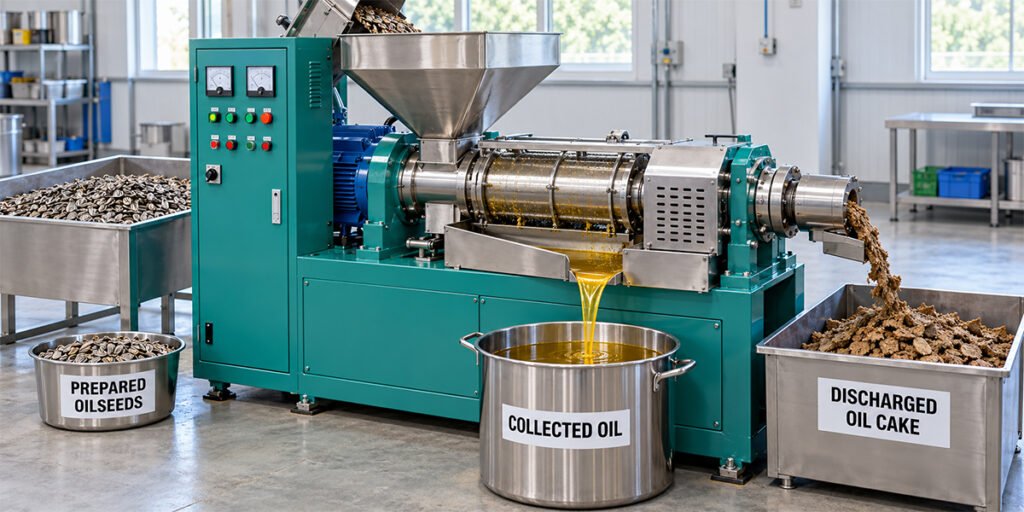
Oil loss during screw pressing is not one single measurement. You should separate the oil remaining in the cake, oil retained in solids, oil held inside equipment, and differences caused by measurement methods.
The following terms describe different parts of the process:
| Term | Meaning |
|---|---|
| Raw material oil content | The total oil naturally present in the seed or kernel |
| Collected oil | Oil recovered at the collection point used for measurement |
| Oil in press cake | Oil that remains in the solid cake after pressing |
| Oil in fine solids | Oil held in particles removed during settling or filtration |
| Retained oil | Oil remaining inside the press, pipes, tanks, or filter |
| Handling loss | Oil lost through leaks, spills, or uncontrolled transfer |
| Measurement difference | An apparent loss caused by different weighing points or time periods |
You cannot calculate true extraction performance from collected oil alone unless the feed basis, test period, and collection point are clearly defined.
For example, oil collected directly below the press may include fine particles and moisture. Oil weighed after settling or filtration may have a different mass. These results should not be compared without explaining the difference.
The press can only work consistently when the incoming material is consistent. Seed variety, storage condition, moisture, impurities, and damage can all affect pressing behavior.
Before changing the machine, inspect the material entering the production line.
Check:
If your business processes several oilseeds, record each material separately. Peanuts, sunflower seeds, sesame, rapeseed, soybeans, and palm kernels do not behave in exactly the same way.
A machine setting that works for one material may cause unstable feeding or a high oil content in the cake when used with another material.
Cleaning protects the press and improves the consistency of the feed. Stones, metal, soil, and other foreign matter can damage working parts or disrupt the pressing chamber.
Cleaning also reduces the amount of unwanted material entering the oil stream. This can make later settling and filtration easier.
A suitable cleaning arrangement may include:
The correct equipment depends on the raw material and the contamination risk. Do not assume that one screen can remove every type of foreign matter.
Poor cleaning may create several problems:
You can review the available oilseed preparation and oil processing equipment when planning the complete process around the press.
Some oilseeds require shelling or dehulling before pressing. Others are processed as whole seeds or kernels. The correct preparation depends on the material and the intended product.
The goal is to present the press with a feed condition that it can process steadily.
If the material is too large, too hard, or poorly prepared, the press may need more adjustment. If it is over-crushed, the feed may become difficult to control and may create more fine particles.
Before selecting or adjusting size preparation equipment, confirm:
Moisture affects how oilseeds move, compress, and release oil inside the press. Material that is too wet may produce a soft cake and unstable discharge. Material that is too dry may create excessive friction, poor feeding, or a cake that is difficult to form.
There is no single moisture value that suits every oilseed and machine. The correct condition should be confirmed through technical testing and the equipment instructions.
We recommend recording:
If the incoming material changes after storage, measure it again before blaming the press for a yield change.
A moisture meter reading should not be treated as a universal operating limit unless the method and material are known. Use comparable measurements when reviewing different batches.
Temperature can affect oil viscosity, material plasticity, and the way the cake forms. In hot pressing, heating or cooking may be part of the preparation process. In cold pressing, the process must be managed to control heat generated by friction and compression.
A heater setting is not the same as the temperature of the oil leaving the press.
When monitoring temperature, record:
Avoid changing temperature and other settings at the same time. If several factors change together, it becomes difficult to identify what caused the result.
If you intend to sell oil with a temperature-related processing claim, confirm the applicable requirements for your market and record the actual process conditions. The machine name alone does not establish whether the finished oil meets a particular claim.
Unstable feeding is a common reason for inconsistent pressing results. When the press receives material too quickly, too slowly, or in irregular batches, the pressure and cake discharge can change.
Check the path from the preparation equipment to the press:
A stable feed helps the screw maintain a more consistent compression pattern. It also makes your measurements easier to compare.
If the press is designed for a feeder, use the specified arrangement or confirm any alternative with the supplier. A larger hopper does not automatically create a stable feed.
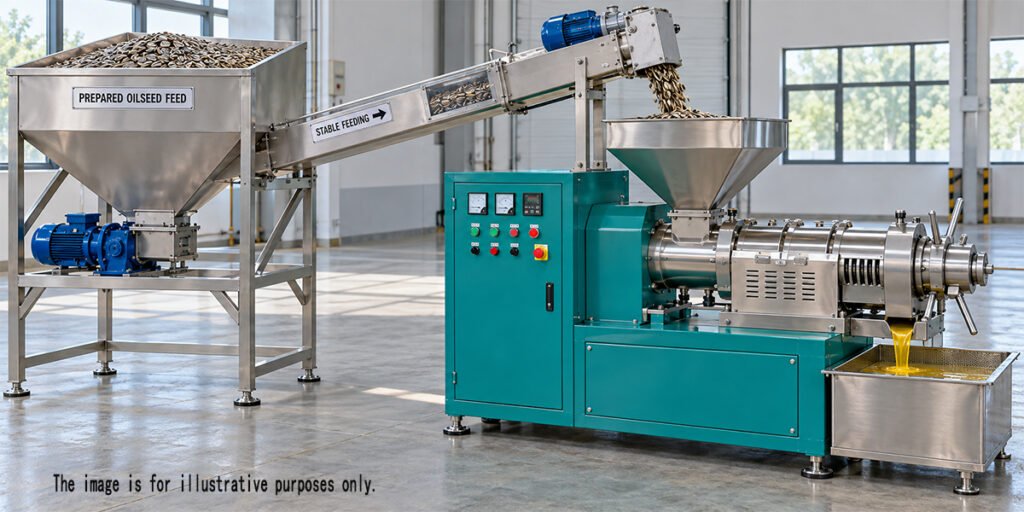
The correct settings depend on the equipment model and the material. These may include feed rate, screw speed, press adjustment, temperature control, and cake outlet settings.
Change one operating variable at a time and record the result.
A useful adjustment record includes:
| Setting or Observation | What to Record |
|---|---|
| Material | Oilseed and batch identity |
| Feed condition | Moisture, preparation, and temperature |
| Feed rate | Measured or controlled rate |
| Screw speed | Setting or measured speed, where applicable |
| Temperature | Measurement point and reading |
| Cake discharge | Thickness, shape, and stability |
| Oil collection | Collection point and weighing time |
| Press interruptions | Blockages, stops, and adjustments |
| Result | Oil and cake measurements using the same basis |
Do not treat a thicker cake or darker oil as proof of higher extraction. These observations may indicate a process change, but they require consistent measurements.
When comparing machines, confirm whether the quoted capacity and oil output were measured under similar material and operating conditions.
Worn parts can change the pressure and material movement inside the pressing chamber. A worn screw, press cage, or cake outlet component may affect both oil separation and cake formation.
The parts that require inspection depend on the machine design. Ask for the operating manual and recommended inspection schedule.
Possible warning signs include:
Do not replace parts based only on appearance. Compare the observed condition with the manufacturer’s criteria and the machine’s operating records.
The oil press maintenance guide can be used as a starting point for routine inspection, but the actual maintenance procedure should follow the manual for your model.
The cake outlet controls how the pressed material leaves the chamber. If the outlet is too open, the material may pass through with more residual oil. If it is too restricted, the press may experience excess pressure, heat, or unstable operation.
The correct adjustment depends on the oilseed and machine design. Ask the supplier how to identify a stable cake condition for your material.
Record:
A cake that looks dry may still contain significant oil. If residual oil is an important performance measure, use an appropriate laboratory method rather than visual inspection alone.
Do not increase pressure without checking machine limits. Excessive adjustment can damage components and create safety risks.
Oil can leave the main product stream with fine solids, filter cake, or other separated material.
Good filtration should improve oil clarity without creating uncontrolled oil retention.
Review:
A filter may remove solids while retaining some oil. This does not automatically mean the filter is unsuitable. The decision should consider oil clarity, product requirements, oil retention, cleaning time, and the value of recovered oil.
You can compare the pressing process with the edible oil refining equipment needed when the crude oil requires treatment beyond mechanical filtration.
Use the same measurement boundary when comparing batches. Weighing crude oil at the press inlet and finished oil after filtration may include several process stages between the two points.
For a defined test, you can calculate:
Collected oil yield (%) = collected oil mass ÷ feed material mass × 100
This calculation describes collected oil on the selected feed basis. It does not automatically equal total oil recovery.
To investigate oil remaining in the cake, you need additional information about:
A simple record can include:
| Record | Example of What to Note |
|---|---|
| Feed material | Oilseed, batch, and preparation |
| Feed mass | Weight entering the press |
| Running time | Measured operating period |
| Collected oil | Weight and collection point |
| Cake | Weight and sample reference |
| Filtration | Method and time before weighing |
| Retained material | Oil left in pipes, tank, or filter |
| Result limits | Unmeasured items and assumptions |
Do not describe every difference between feed mass and collected oil as avoidable oil loss.
If you are testing a new setting or comparing equipment, keep the test conditions stable.
A useful test should record:
Run a sufficient period to reach stable operation before recording the main result. A short startup period may not represent normal production.
If the result will be used in a purchase agreement, define the acceptance method in writing. State the feed material, preparation, operating conditions, measurement method, and responsible people.
For a complete equipment discussion, you can review the oil press product range and prepare your material and capacity information before requesting a quotation.
No. The result may be affected by the oilseed, moisture, preparation, feed rate, temperature, wear parts, and cake outlet. Compare the same material and conditions before judging the machine.
No. Temperature can affect oil flow and pressing behavior, but excessive heat may change oil quality and create other process problems. Use the operating conditions confirmed for the material and machine.
Usually, you should confirm settings for each material. Different oilseeds have different physical properties and preparation needs. Record the conditions separately when changing raw materials.
Do not increase pressure without checking the equipment instructions and other process conditions. First review feed preparation, moisture, feeding stability, wear parts, and the cake outlet.
Filtration removes suspended solids, but some oil may remain in the separated material or filter. Check the filter capacity, draining procedure, and residue handling if this affects your production result.
Use the same oilseed, preparation method, feed basis, running period, collection stage, and measurement method. Ask each supplier to state the conditions behind its capacity and yield figures.
Reducing oil loss during screw pressing begins with consistent raw material, suitable preparation, stable feeding, controlled operation, good maintenance, and clear measurement.
At Fude Machinery, we recommend reviewing the complete process around the press rather than judging performance from one number. A clear test record can show whether the main issue comes from material preparation, machine settings, equipment wear, filtration, or measurement boundaries.
Send us your oilseed type, daily processing target, feed condition, and current pressing problem. We can then discuss the machine configuration and supporting equipment needed for your production plan.
Want to make peanut oil? It needs more than just squeezing peanuts. Understanding the steps is key. Making peanut oil involves key steps. These include preparing the peanuts, pressing the oil out, and then cleaning the oil. We do this to get high-...
View details
As one of the world's most widely consumed vegetable oils, palm oil's industrial chain spans multiple sectors including food processing, biofuels, and daily chemicals. Establishing an efficient and sustainable palm oil mill requires systematic pla...
View details
The heating and pressing process of a spiral oil press includes multiple steps such as preheating, pressing, temperature and moisture control. These links are interrelated and influence each other, jointly determining the squeezing effect and oil ...
View details
For home use, a small, semi-automatic or manual assisted tea seed sheller that is affordable, low-noise, safe and reliable is a more suitable choice.
View details