 Oil Press Equipment and Oil Refining Machinery for Sale – Start Your Oil Press Business
SEARCH WHAT YOU WANT
Search allProductNews
SEARCH
Edible oil refining losses include several different things: components intentionally removed from crude oil, useful oil carried into separated materials, and oil lost during handling. A difference between crude oil input and collected finished oil can also reflect material still inside the equipment or incomplete measurements.
At Fude Machinery, we recommend checking where the material went before judging equipment performance. A lower finished oil weight does not automatically mean the refinery wasted that entire amount.
This guide explains the main material flows, how to record a batch, and what to ask when comparing refining equipment.
The term “refining loss” needs a clear definition before you compare figures. Some reports use it for the difference between crude oil input and finished oil output. Others focus on the loss of neutral oil during treatment.
Neutral oil refers mainly to the triglycerides that make up the useful oil you want to retain. This is different from free fatty acids, water, gums, and other components that the selected process may need to remove.
We recommend separating the following categories.
| Category | What It Means | How to Interpret It |
|---|---|---|
| Intended removal | Components removed to meet the finished product requirements | Part of the selected treatment, not automatically avoidable waste |
| Neutral oil carried out | Useful oil leaving with gums, soapstock, spent adsorbent, or other separated materials | A process loss to measure and investigate |
| Handling loss | Oil lost through leakage, spills, or uncontrolled disposal | Requires investigation and corrective action |
| Retained inventory | Oil remaining in tanks, pipes, filters, or other equipment | Not necessarily lost; it must be accounted for |
| Measurement difference | An apparent gap caused by inconsistent weighing, timing, or records | Must be resolved before drawing conclusions |
Crude oil is not composed entirely of the material that will become finished refined oil. Its composition depends on the raw material, extraction method, storage, and previous treatment.
The selected refining process removes components that conflict with the target product requirements. However, some useful oil may also leave with separated materials.
An industry overview from Desmet explains the main refining routes: chemical refining removes free fatty acids through neutralization and separation, while suitable physical refining systems remove them through steam stripping as a distillate.
We recommend asking two separate questions:
These questions help you evaluate performance without assuming that every reduction in mass could have been prevented.
Material can leave the main oil stream at several stages. The relevant outlets depend on the refining route and equipment configuration.
For an overview of the equipment involved, see our guide to equipment used for edible oil refining.
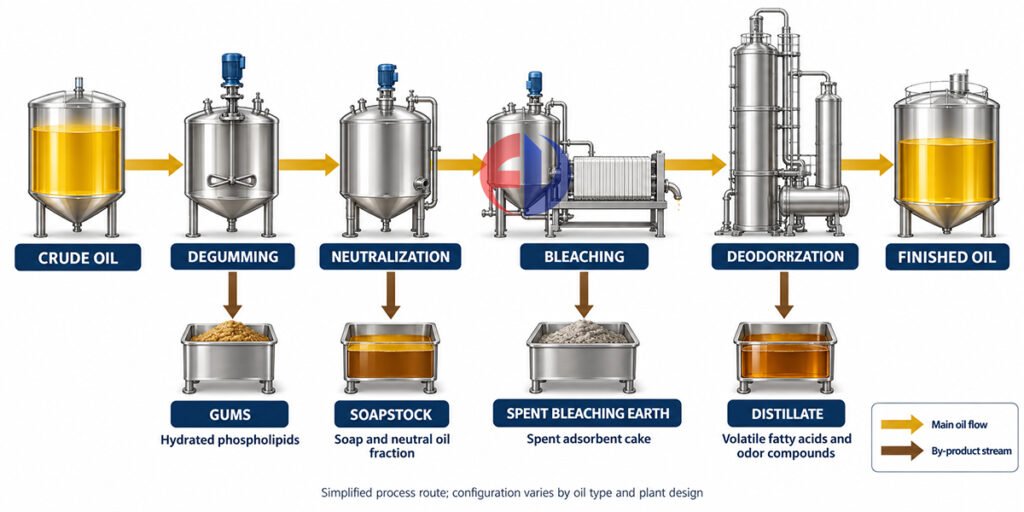
Degumming separates phospholipid-rich material from the oil. The separated gums may contain water and entrained oil as well as the components being removed.
The total weight of discharged gums should not be reported as the weight of lost neutral oil. These are different measurements.
We recommend recording the discharged material and using appropriate analysis when you need to establish its oil content. Changes in feed quality or separation performance should be reviewed against the same measurement basis.
In chemical refining, free fatty acids react with alkali to form soaps. The separated material, commonly called soapstock, can also contain water, neutral oil, and other components.
This means that a soapstock weight does not directly tell you how much useful oil was lost.
Alfa Laval’s neutralization systems overview describes the separation of soapstock and wash water from the oil. When evaluating this stage, we recommend reviewing both the incoming oil conditions and the composition of the separated streams.
Chemical dosage, mixing, separation, and operating conditions should be checked by the responsible technical personnel. Increasing or decreasing a setting without understanding the cause may affect both yield and product quality.
Bleaching uses adsorbents to treat the oil, followed by filtration to remove the spent material. Some oil can remain with the filter cake and spent adsorbent.
The weight of spent bleaching earth includes the adsorbent itself. It may also include retained oil and other material. It is not a direct measurement of oil loss.
We recommend recording adsorbent addition, the discharged filter cake, and any available analysis of retained oil. Compare results using consistent sampling and reporting methods.
The goal is to achieve the required oil quality while controlling avoidable losses. Reducing adsorbent use without checking the finished product is not a complete improvement strategy.
Deodorization removes volatile compounds under the specified operating conditions. In physical refining, free fatty acids are also removed through the stripping process.
The collected distillate is a separate process stream. Its weight should not automatically be treated as neutral oil loss.
We recommend identifying what the distillate contains when its composition matters to the evaluation. Collection conditions and any water present should also be considered before comparing records.
Where required, dewaxing or winterization separates components that can affect low-temperature clarity. The separated material may also retain oil.
We recommend evaluating this stage against the agreed clarity requirement and the feed composition. A change in the quantity removed does not, by itself, prove that the equipment is performing better or worse.
Oil can remain inside transfer lines, filters, vessels, and storage tanks at the end of a measurement period.
If you weigh the crude oil entering a batch but collect only part of its finished output before closing the record, the difference may look like a loss.
We recommend identifying inventory at the start and end of the period. Oil collected during the next shift should not be counted as new production if it belongs to the previous batch.
Different crude oils can require different amounts of treatment and removal. Even batches of the same oil type may differ.
Useful information can include free fatty acids or acid value, moisture, insoluble impurities, phosphorus, and other indicators relevant to the process.
| Feed Information | Why It Matters to the Review |
|---|---|
| Oil identity and source | Establishes which feedstock is being compared |
| Free fatty acids or acid value | Helps explain deacidification requirements |
| Moisture | Helps distinguish water removal from oil loss |
| Gums and related analysis | Supports evaluation of degumming requirements |
| Insoluble impurities | Helps explain material removed during separation or filtration |
| Previous treatment | Identifies whether the feed has already been settled, filtered, or degummed |
| Batch and sampling details | Shows what the test results represent |
Keep original laboratory units and reporting methods. Acid value and free fatty acid percentage are related measures, but they are not interchangeable numbers.
We recommend comparing batches with similar feed characteristics whenever possible. If the incoming oil changes, document that change before attributing the yield difference to the machine.
For a clearly defined batch, a simple collected finished oil yield is:
Collected finished oil yield (%) = finished oil collected ÷ crude oil charged × 100
Both quantities should use the same mass unit. The batch boundaries and collection stage must also be clear.
Suppose a batch receives 1,000 kg of crude oil and produces 950 kg of collected finished oil.
The collected finished oil yield is:
950 ÷ 1,000 × 100 = 95%
The initial difference is 50 kg. This example does not establish that 50 kg of neutral oil was wasted.
The difference could include intentionally removed components, oil carried into separated streams, retained inventory, samples, handling losses, and measurement error.
If 8 kg of oil from that batch is confirmed to remain inside equipment at the cutoff time, it should be recorded as inventory. It should not be added to collected finished oil unless it is subsequently recovered and meets the relevant product requirements.
These numbers are illustrative. They are not expected performance figures for a specific oil or Fude Machinery model.
A complete material balance also considers water, chemicals, adsorbents, and other materials entering the process. Its outlets may include residues, wastewater, vapors, samples, and changes in equipment inventory.
Therefore, you cannot simply subtract the total weight of wet residues from crude oil input to calculate neutral oil loss.
We recommend using a process-specific balance prepared or reviewed by technical personnel when investigating unexplained differences.
A useful record connects the feed oil, operating period, product, and separated materials. It should be possible to trace each measurement to the same batch or defined reporting period.
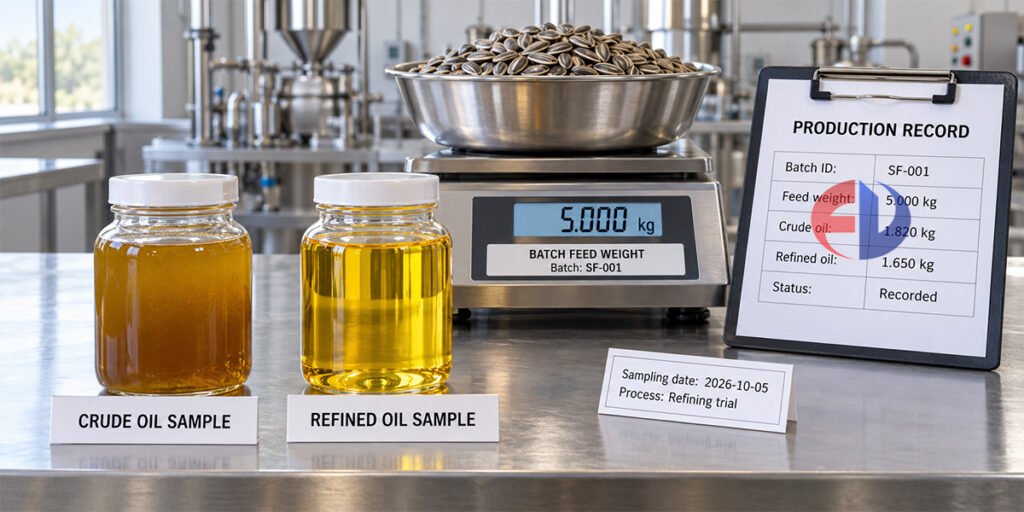
| Record Item | What to Include |
|---|---|
| Batch identity | Date, reference number, oil type, and source |
| Feed analysis | Available results, sampling details, units, and methods |
| Crude oil charged | Measured mass and weighing method |
| Opening inventory | Relevant oil already inside the defined system |
| Added materials | Water, chemicals, adsorbents, and other recorded additions |
| Finished oil collected | Measured mass and defined collection point |
| Separated streams | Identified gums, soapstock, spent adsorbent, distillate, and other outputs |
| Samples and transfers | Material removed for testing or moved outside the measurement boundary |
| Closing inventory | Relevant material remaining inside the system |
| Product quality | Results used to confirm whether the collected oil meets the target |
| Operating changes | Interruptions, adjustments, reprocessing, or equipment issues |
| Unresolved differences | Missing measurements or quantities that remain uncertain |
For continuous production, use a consistent reporting period and account for changes in inventory. Comparing input from one period with output from another can create misleading results.
If tank levels or flow measurements are converted into mass, document the method and any temperature or density assumptions. Do not compare raw volume readings as though they were already equivalent mass measurements.
Start by confirming that the apparent change is real.
We recommend reviewing measurement and feed conditions before changing the process.
Confirm that the input and output records cover the same batch or reporting period. Look for delayed transfers, unfinished batches, retained oil, or material counted twice.
Review weighing equipment, container tare weights, and tank readings. Record any measurement that is estimated rather than directly measured.
Check whether the incoming oil came from a different source or had different moisture, acidity, gums, or impurities.
A higher removal requirement can reduce finished oil yield even when the equipment is operating as intended.
If useful oil appears to be leaving with a residue stream, obtain representative samples and use suitable analysis. Visual inspection alone cannot quantify neutral oil loss.
Compare the results with previous records using the same sampling and reporting basis.
Technical personnel should review relevant dosing records, separation performance, filtration, transfer procedures, and equipment condition.
Record which variable changed and why. Changing several settings at once can make it difficult to identify the cause of an improvement or deterioration.
We recommend checking finished product quality alongside yield. A higher collected output is not an improvement if it fails the required specification.
Equipment selection should support both the required product quality and a measurable operating process. A low-loss claim is difficult to evaluate if the proposal does not define the incoming oil or the measurement method.
When discussing our edible oil refining equipment, provide the feed analysis, required processing capacity, and target finished oil specification.
Ask the supplier to clarify:
Do not assume that one quoted percentage applies to every oil or operating condition. Ask for the basis behind the number.
Some separated materials may have a use or commercial value, depending on their composition and the available market.
However, possible by-product income should be assessed separately from finished edible oil yield.
We recommend distinguishing:
Do not assume that every residue can be sold or returned to the edible oil process. Its suitability must be assessed for the intended use.
A realistic cost calculation uses confirmed quantities, actual handling requirements, and achievable prices rather than treating all separated material as either worthless waste or guaranteed income.
There is no single percentage that reliably describes every project. The result depends on feed quality, refining route, product requirements, operating conditions, and measurement method. Compare figures only after confirming that these conditions are compatible.
Not necessarily. More material may need to be removed from the incoming oil, or the records may include retained inventory and measurement differences. Investigate those factors alongside equipment performance.
No. Soapstock can contain soaps, water, neutral oil, and other components. Its total weight does not establish neutral oil loss. Appropriate sampling and analysis are needed to determine its composition.
No. The routes must be suitable for the feedstock and required product. Compare quality results, feed conditions, utilities, consumables, separated streams, and measurement methods as well as finished oil yield.
No. Filtration addresses specific parts of the process. It does not eliminate components that must be removed elsewhere, and filtration itself can retain oil in the separated material or equipment.
A zero-loss claim needs careful definition. Refining normally removes selected components, so crude input and finished product weights may differ. Even when discussing only neutral oil, any performance claim should state the measurement method and operating conditions.
Edible oil refining losses should be evaluated through clear measurements and identified material streams. Separate intended removal from neutral oil loss, retained inventory, and measurement differences.
We recommend starting with a feed analysis and a consistent batch record. These provide a stronger basis for improving operation and comparing equipment than a single unexplained percentage.
Send Fude Machinery your crude oil type, available analysis, planned processing capacity, and finished product requirements. Use the inquiry options on our website to discuss the refining configuration and the conditions needed to assess its performance.
Vegetable oils are lipid substances extracted from plant seeds, fruits, or other tissues, and belong to the category of natural lipids. Establishing a vegetable oil plant is a multi-faceted, multi-disciplinary system engineering project that requi...
View details
Oil press is a kind of equipment used to extract oil from oil crops, which can press olives, peanuts, palm, soybeans and many other oils.
View details
Are you seeking to produce top-quality edible oils? Do you want to ensure your refining process is efficient and precise? I am Fude Machinery. My company specializes in oil processing equipment. I understand the demand for excellence. A high-preci...
View details
Got crude avocado oil but it's not quite right? Wondering if refining is necessary and what it involves? Let's explore why and how avocado oil is refined for quality and stability.Refining removes impurities like free fatty acids, gums, pigments, ...
View details