 Oil Press Equipment and Oil Refining Machinery for Sale – Start Your Oil Press Business
SEARCH WHAT YOU WANT
Search allProductNews
SEARCH
A useful oil press machine test should show what the machine can do with a clearly identified material under recorded operating conditions. Before buying, check the seed preparation, feed weight, running time, collected oil, cake output, and equipment configuration. A short video of oil flowing from a press does not provide enough information to compare performance.
At Fude Machinery, we recommend agreeing on a simple test plan before discussing results. This helps you understand what was measured, what remains uncertain, and whether the demonstration represents your planned production.
This guide explains what buyers should record during a trial and how to use the results when discussing an equipment purchase.
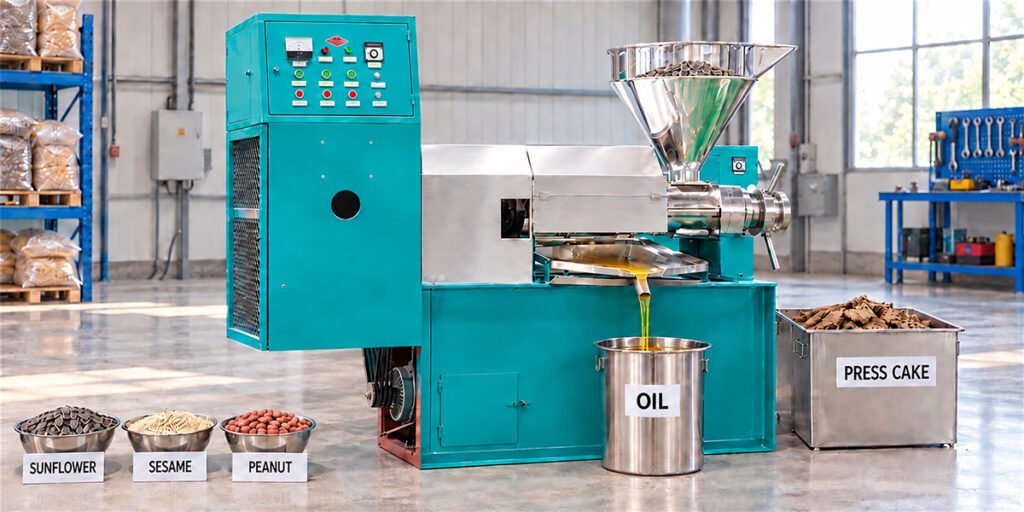
Start by identifying the question you want the trial to answer.
You may want to know whether a machine can process your material, whether it can maintain a required feed rate, or how much collected oil it produces under a particular preparation method. These are related questions, but they require different records.
We recommend defining the purpose before choosing the test material or duration.
| Test Objective | Evidence to Request |
|---|---|
| Material suitability | Identified feedstock, preparation details, and observed operating behavior |
| Processing capacity | Measured feed weight and a clearly defined operating period |
| Collected oil yield | Feed weight, oil weight, collection stage, and matching measurement boundaries |
| Cake condition | Representative cake samples and recorded observations |
| Oil remaining in cake | Laboratory analysis with the reporting basis identified |
| Operating requirements | Staffing, preparation, adjustments, and included supporting equipment |
| Energy use | Metered consumption for a defined equipment scope and test period |
A material trial is not automatically a formal acceptance test. If the results will be used to approve equipment before shipment, the test procedure and acceptance conditions should be agreed in writing.
The trial material should resemble what your oil mill will actually receive. A demonstration using a different seed variety or preparation method may be useful, but its results should not be treated as a direct prediction for your own material.
Tell the supplier the oilseed type, origin if known, storage condition, and preparation state. Explain whether you normally buy whole seeds, kernels, dried material, or material that has already been cleaned or conditioned.
We recommend assigning a sample or batch number so the material can be linked to the test record.
The condition of the material entering the machine is part of the test.
Record any cleaning, shelling, crushing, drying, heating, or conditioning performed before pressing. If moisture is measured, keep the result and the measurement method.
Do not compare two machines as though the conditions were identical if one uses prepared kernels and the other uses a different feedstock.
| Material Detail | What to Record |
|---|---|
| Identity | Oilseed name, variety if known, and batch identification |
| Incoming condition | Whole seed, kernel, dried material, or another specified form |
| Preparation | Cleaning, shelling, crushing, heating, or other treatment |
| Moisture | Measured value and method, when available |
| Weight | Material weight before preparation and actual weight entering the press |
| Previous processing | Whether the material is fresh feed or cake being pressed again |
If you plan to send material to a supplier, confirm the required quantity and shipping arrangements first. The amount needed depends on the machine and the agreed test plan.
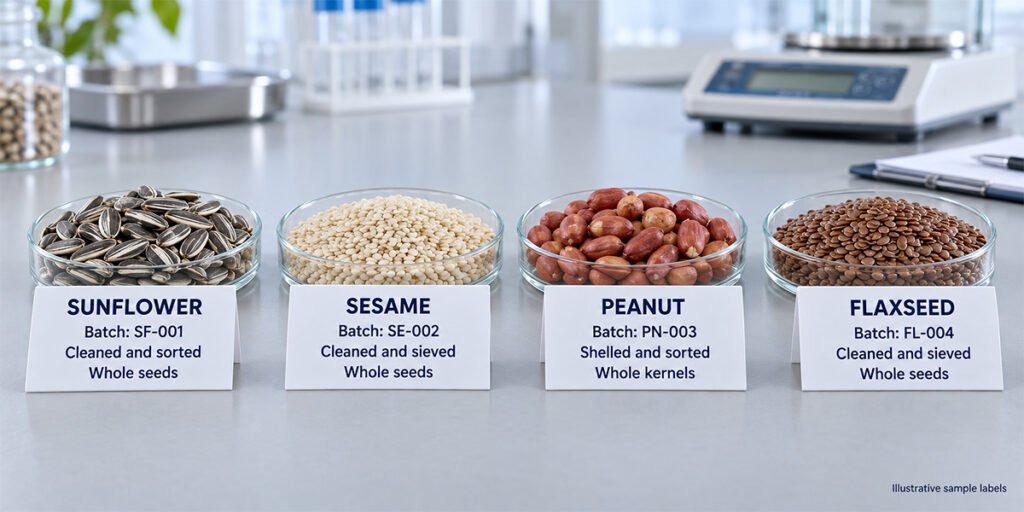
The test record should identify the exact equipment configuration. A result is less useful if you cannot connect it to the model and accessories being quoted.
Ask for the model identification and the supporting equipment used during the trial. This may include feeding equipment, heaters, oil collection tanks, or filters.
For a screw oil press, record the relevant operating settings supplied by the operator, such as screw speed where adjustable, temperature settings, and the pressing arrangement.
For a hydraulic oil press, record the load per batch and the complete batch sequence. Loading and unloading time matter when evaluating practical output.
A machine may need preparation or warm-up before the measured part of a trial begins. Material and oil can also remain inside the equipment when the measurement period ends.
Agree on when measurement starts, when it stops, and how retained material will be handled. Without this information, the feed weight and collected output may not describe the same production period.
For a continuous press, ask the operator to distinguish startup from the recorded running period. Record interruptions, changes in settings, and any additional material introduced.
For a batch press, record the complete cycle if the purpose is to estimate daily production. A pressing interval alone does not account for loading, unloading, and preparation for the next batch.
There is no single test duration suitable for every machine and material. The planned duration should be long enough to address the agreed objective, and any limitation should appear in the report.
Throughput describes how much material the machine processes during a defined period. It should not be confused with the amount of oil produced.
A simple calculation is:
Average feed throughput = measured feed mass ÷ measured operating time
For example, if a test processes 120 kg of prepared material during a 45-minute measured period, the calculated average is 160 kg per hour.
This is an illustrative calculation, not a machine rating. It describes that test period only. It does not prove that the machine will maintain the same result across a full working day or with another material.
We recommend reporting both the measured running period and any additional time relevant to production planning.
| Time Record | Why It Matters |
|---|---|
| Preparation and startup | Shows work needed before measured pressing |
| Measured pressing period | Provides the basis for the reported running throughput |
| Interruptions | Identifies stops or adjustments during the trial |
| Cleaning and changeover | Helps assess the broader operating schedule |
| Full batch cycle, where applicable | Supports a practical batch-production calculation |
If a test includes downtime, state whether that time is included in the throughput figure. Buyers need the same time basis when comparing results.
Collected oil yield, seed oil content, and oil recovery are different measurements. A report should identify which one it presents.
For a defined test, collected oil yield can be calculated as:
Collected oil yield (%) = collected oil mass ÷ feed material mass × 100
Suppose 100 kg of prepared feed produces 32 kg of collected oil at the specified measurement stage. The collected oil yield is 32% on that feed basis.
This example is hypothetical. It is not a performance claim for any oilseed or Fude Machinery model.
Oil measured directly at the press outlet may contain suspended material or moisture. Oil weighed after settling or filtration may give a different result.
Record whether the reported mass refers to:
Use the same collection stage when comparing tests. Also record whether retained oil in tanks, pipes, or filters is included.
State whether feed weight refers to purchased material, cleaned seeds, or prepared kernels entering the press.
Removing shells or other material changes the denominator. A percentage based on kernels should not be directly compared with one based on unshelled material without explaining the difference.
We recommend weighing oil rather than converting an observed volume into mass without a documented conversion basis.
To estimate the share of available oil recovered, you need a reliable measurement of the oil originally present in the feed, together with compatible output measurements.
Collected liquid weight alone does not establish this figure. If recovery is an important purchase criterion, agree on the sampling and laboratory measurements before the trial.
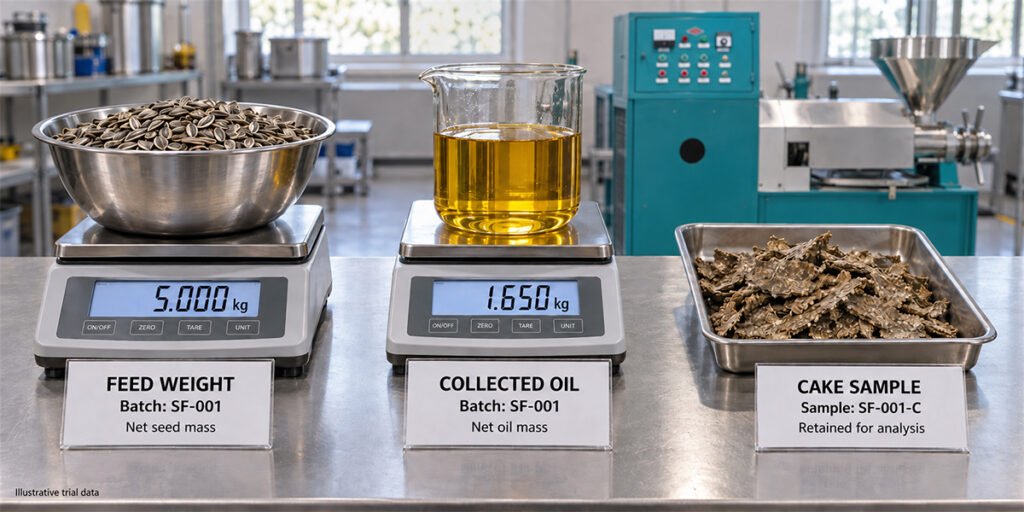
Cake observations can help describe how the machine operated. Record its appearance, discharge consistency, and any visible changes during the test.
However, appearance or touch alone cannot establish the residual oil content of the cake. Ask for a laboratory result if remaining oil is a key performance measure.
A useful sample record should include:
Moisture can affect how results are expressed. Check whether the laboratory reports oil content on an as-received or dry-matter basis before comparing values.
If cake is pressed again, record the additional time, collected oil, and energy separately. Results from repeated pressing should not be presented as though they came from a single pass.
Temperature and power figures need context.
For temperature, identify the measurement location, instrument, and time. A heater setting, a press surface reading, and the temperature of collected oil describe different things.
If your product plan includes a temperature-related processing claim, agree on what must be measured and how. The machine label alone does not establish the conditions experienced by the oil.
Installed motor power is not the same as electricity consumed during a trial.
If energy use matters to your comparison, request a meter reading for a defined equipment scope and period. State whether it includes the press, heaters, feeding equipment, filtration, and startup.
A useful comparison can express electricity use per measured quantity of feed, provided both tests use the same scope and calculation basis.
If no meter is used, report energy consumption as unmeasured rather than estimating it from the motor nameplate.
A remote demonstration can help you inspect the setup and understand the operating sequence. Its value depends on what the video and supporting records actually show.
We recommend agreeing on a simple recording list before the demonstration.
| Video or Record | What It Should Show |
|---|---|
| Machine identification | Model and tested configuration |
| Material identification | The agreed batch and preparation state |
| Weighing | Containers, tare weights, and readable scale results |
| Timing | Start, stop, and any interruptions |
| Operation | Feeding, oil collection, and cake discharge |
| Test outputs | Clearly identified oil and cake containers |
| Final record | Measurements and notes linked to the same trial |
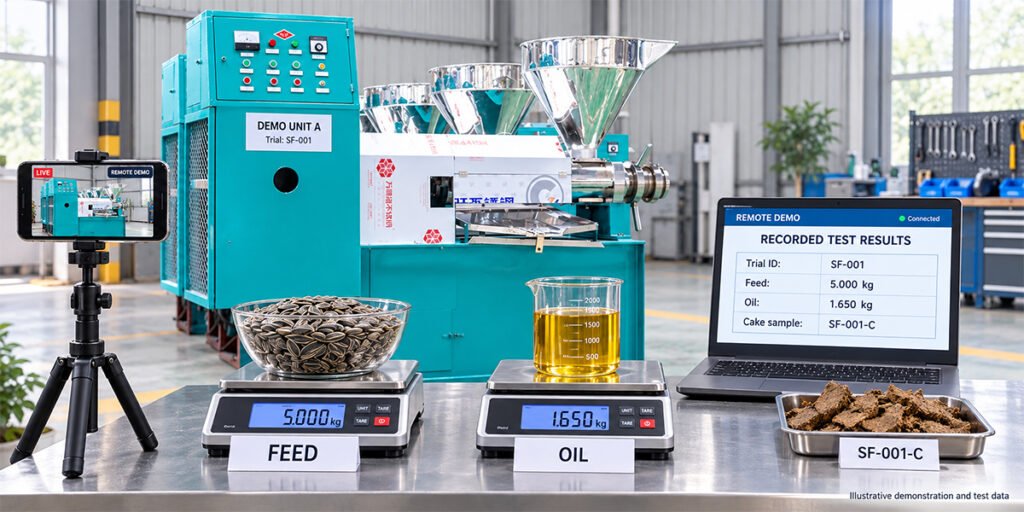
A concise written record makes the trial easier to review and compare. It also prevents important details from being lost in messages or video commentary.
We recommend using the following checklist.
| Record Field | Information to Include |
|---|---|
| Test identity | Date, location, and trial reference |
| Equipment | Model, configuration, and accessories used |
| Material | Oilseed, batch, preparation, and available analysis |
| Test purpose | Suitability, throughput, yield, or another defined objective |
| Feed measurement | Mass and preparation stage at which it was weighed |
| Time measurement | Startup, measured running time, stops, and cycle time where applicable |
| Oil measurement | Mass, collection stage, and treatment before weighing |
| Cake measurement | Mass where measured, sample identification, and available analysis |
| Operating conditions | Relevant settings and temperature measurement details |
| Energy | Metered consumption and equipment scope, if measured |
| Repeated pressing | Number of passes and separately recorded results |
| Observations | Adjustments, interruptions, unusual behavior, and operator tasks |
| Limitations | Unmeasured items and differences from the planned production |
| Review | People responsible for recording and checking the results |
You can use this record when discussing machines in our oil processing equipment range. Confirm that the model and configuration discussed in the quotation match the equipment used in the trial.
Use trial results to resolve specific purchase questions. Do not treat one successful run as proof of every performance claim.
After the demonstration, review three areas:
If a result will become a contractual requirement, record the applicable conditions and verification method in the purchase documentation.
We recommend keeping the original test data, sample references, and videos together. A summary is easier to trust when it can be checked against the underlying record.
The amount depends on the machine, startup needs, and test objective. Confirm the required quantity with the supplier before sending samples. A small sample may support a limited demonstration without establishing sustained production capacity.
Not as a direct comparison of machine performance. Different materials and preparation conditions can produce different results. Compare machines using equivalent material and measurement methods wherever practical.
Not by itself. Check the feed basis, preparation, pressing passes, collection stage, running time, and quality requirements. A larger collected liquid weight does not automatically mean more usable oil or a more economical process.
No. A demonstration may be exploratory. A formal factory acceptance test should follow an agreed procedure with defined conditions, records, and acceptance criteria.
A useful oil press machine test connects results to an identified material, machine configuration, and measurement method. Record the feed condition, processing time, collected oil, cake samples, and any limitations.
At Fude Machinery, we recommend preparing these questions before evaluating a machine demonstration. Clear records make it easier to discuss suitability and avoid comparing figures that use different conditions.
Send us your oilseed type, planned daily processing volume, and the questions you want a trial to answer. Use the inquiry options on our website to discuss the proposed equipment and whether a suitable material trial can be arranged.
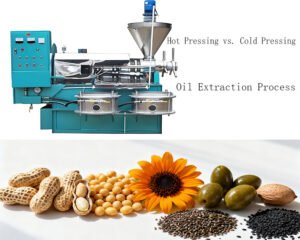
You have decided to start a peanut oil business. That is a great choice. Now you face the most important technical decision: which peanut oil press process should you use? The two main options are hot pressing and cold pressing. Your cho...
View details
Need equipment for making olive oil? Figuring out the right size can be tough. We can help you find the perfect fit. Olive oil equipment scales range from small village presses to large industrial lines. Options include hydraulic presses, screw pr...
View details
Soybean oil press is one of the commonly used equipment for squeezing soybean oil
View details
Building a soybean oil production line involves setting up a series of connected machines that take raw soybeans and turn them into crude oil and a valuable high-protein meal. This is a complete system, often called a soybean oil processing plant....
View details